Saturday, 24 April 2021

远 | 遠

Today we move on to a simple add-on to our Chinese character family based on 元 and 袁 we just learnt - 远, whose Traditional Chinese character is 遠.

Looking at 远, it is composed of 元 and 辶, we already know that 元 can mean start, while 辶 is 辵 which means walk. So 远 means start to walk? This is a bit ambiguous for what it really represents.

Let us leave 远 aside for a while and look at its counterparty 遠. 遠 is composed of 袁 and 辶. 袁 we know that its original meaning is "to take a cloth". So 遠 means to take a cloth (with you) and walk, which in term means that you would travel far away from home.

That is it, 远 | 遠 means far away. for example 远方.

As usual, below is the evolution history of 远 | 遠:

evolution history of 远 | 遠

And enjoy a Chinese calligraphy with 远 | 遠 inside:

远- 非淡泊无以明志;非宁静无以致远。


Saturday, 27 March 2021

 Today we move on to a few Chinese character 袁, which is related to 衣 we just learnt. From the modern form 袁, we can tell that its bottom part  is part of the 衣. By looking at its ancient scripts, it is even more obvious:

evolution history of 袁


Oracle script is quite obvious to have a hand which holds a cloth . Another Oracle script added the round collar of the cloth. And Bronze script moved the hand to upper part of 袁. Following characters of 袁 followed the pattern of Bronze script till current Regular script 袁.

So 袁 contains the original meaning of "taking a cloth", usually it refers to taking spare clothes when you would like to travel far away from home. 

In ancient China, there is one officer whose duty is to prepare clothes for kings or governors. As part of the usual practice of Chinese ancestors, his descendants started to use 袁 as their family name. Now 袁 is used as family name only.

In order to represent the original meaning that 袁 represents - to prepare clothes for travelling away from home, Chinese ancestors added 辵, whose simplified version 辶 (details at https://xiongzou.blogspot.com/2015/11/learn-one-chinese-character-day_14.html) to 袁 to represent meaning of far away, which Chinese character we will study in our next post.

That is all for 袁, now it is time to enjoy a Chinese calligraphy with 袁 inside:

致远 - 袁江

Saturday, 30 January 2021

Before we move on to our character 远 or its Traditional counter party - 遠, we need to prepare ourselves with good understanding of 元 and 袁 first.

Today we will study 元. It is quite clear that, 元 is composed of 二 and 儿. Does it mean 2nd kids in the family? Sounds interesting. Let us see if we can confirm our guess with its ancient scripts.

evolution history of 元


Looking at Oracle script of however,  its upper part in Oracle Script is actually Chinese character 上 (details can be found at https://xiongzou.blogspot.com/2017/10/learn-one-chinese-character-day.html) instead of 二. Since refers to a person without doubt, the drawingthus should contain two potential meanings:

1. something above a person: sky or heaven.
2. upper part of a person: header.  

Actually both are the original meaning of 元. Just another Chinese character 天 was created to dedicate to mean sky or heaven.

for example in 元气, 元 means sky or heaven. and in 元首, 元 means head.

Same as English word head and heading, our Chinese character 元 contains the same context and is borrowed to represent meaning of first, beginning, origin, above or primary

Till now we full prepared ourselves to understand the first public holiday in China, which is 元旦. Translation of 元旦 literally is first sunrise, which means first day of a year!

Do not forget the meaning of sky and heaven that 元 represents as well! As great as the sky, 元 is also used to mean great.  for example: 元勋.

That is all, time to enjoy a Chinese calligraphy with 元 inside:

元德


Today we need to detour to a new Chinese character 衣 before we can continue our journey to 远 | 遠.
Looking at its modern form 衣, there is almost no clue for us to guess its meaning. Let us examine its ancient scripts, as usual, to see if there is any hints to get.


Evolution history of 衣

With its Oracle scriptand , Bronze script , and Seal script , if you knew the meaning of 衣, and were familiar with Chinese culture, it would be pretty clear to you that is the drawing of the object that 衣 represents, as shown in below picture:

衣服

Yes, 衣 is the drawing of an upper garment or clothing. for example 大衣.

衣 naturally contains the meaning of covering or wrapping, thus 衣 is also used to represent wrapping items in certain scenarios, for example 糖衣炮弹.


Looking back at 衣's evolution history, when 衣 came to Clerical script , it has transformed to become very similar with what we write today.

That is all for 衣, time to enjoy Chinese calligraphy with 衣 inside:

朱雀桥边野草花,乌衣巷口夕阳斜;
旧时王谢堂前燕,飞入寻常百姓家。
  

Saturday, 28 November 2020

 We have learnt 朋 in our last post. Today we move on to the character which is always used together with 朋 as 朋友, which means friend.

what does 友 mean here?  Recall what we have learnt when we studied 有 (https://xiongzou.blogspot.com/2015/12/learn-one-chinese-character-day_29.html) and 又 (https://xiongzou.blogspot.com/2015/12/learn-one-chinese-character-day_27.html), we can tell that 友 is composed of two hands. And we would not be surprised that 友 sounds much like 又 as well as 有.

However till now, we cannot give any reasonable guess for what 友 represents. As usual, its ancient scripts should help us to have a better understanding of 友, as shown below:

evolution history of 友

From its Oracle script, it is quite clear that  is drawing of two hands (both right hands) (to work / point to same direction). It is more likely the same idea of picture below:


One of its Bronze script variant , with an extra 口 underneath two hands. We believe it means to SAY: "let us work together".

Thus 友 originally means "two person who works together for the same goal or purpose". That is why it is explained by 《文解字》 as "同志为友", which is translated to English as: people who share the same 志 are 友. What does 志 mean? 志 means where your heart is. Details can be reviewed at https://xiongzou.blogspot.com/2016/08/learn-one-chinese-character-day_9.html .

Please note the subtle differences in the meaning of 友, comparing to 朋 in its original meaning.  But now 友 is always used as friend. For example 好友.

If 友 is used as verb, it means to make friends with. 友爱.

That is all for 友, time to enjoy Chinese calligraphy with 友 inside:

独山莫友芝书


Our new Chinese character today is 自. Looking at this modern form, it is not possible to guess the meaning of 自. Let us go through its ancient scripts and probably we will get hints there:

evolution history of 自

Oracle script might still be too simple to guess. but its Bronze script shows very clearly what 自 represents:


Now if we look back at its Oracle script , it is clear that also vividly represents the drawing of nose, but without mustache, as well. 

If you know the Chinese character which means nose - 鼻, now you can immediately tell that 鼻 is composed of 自 and 畀. From the regular pattern of how Chinese characters were created, 自 should be related to nose.

From the evolution history of 自, laziness of human nature demonstrates its power again, 自 is simplified from complex to , and further simplified during Seal script era:  . is every close to what we are writing today: 自.

Yes, 自 originally means nose, which is eventually replaced by the new character 鼻, for 自 was eventually borrowed to represent different meanings.

During our daily conversation, we usually point to our noses to mean me or myself. And sometimes even point to other-body's nose to mean him. Chinese ancestors took this scenario to use 自, which is nose, to mean me or self. for example 自己.

自己
 

The same hidden meaning of nose should be presented in western culture as well. In the fable story of Pinocchio, whenever he lied, his nose would grow longer, which probably represents the result of growing ego of a person.


And nose is the vital organ for breathe and airflow starts from it. 自 thus also contains the meaning of from, start and since. for example 自从.

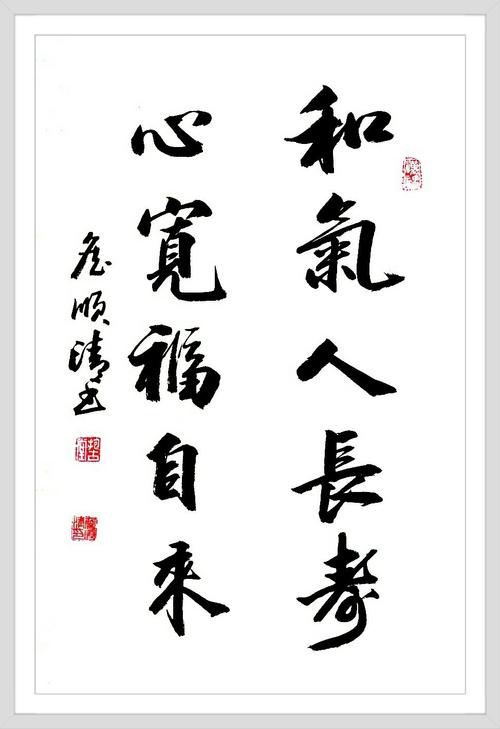
That is all for 自, time to enjoy a Chinese calligraphy with 自 inside:

和气人长寿;心宽福自来。


Sunday, 18 October 2020

朋 | 倗

We have successfully interpreted the meaning of the sentence: "学而时习之,不亦悦乎?" its next sentence is "有朋自远方来,不亦乐乎?" In our following learning journey, we will prepare ourselves to understand it properly.

Our character today is 朋. What does it mean by grouping two 月 together? We have learnt that 月 can represent either moon or meat when it is used as Chinese radical. You can review the related posts as below:

So does 朋 means a lot of meat or kind of meaning "bright" like 明? After we see its Oracle scripts, it will be clear that 朋 has nothing related to 月 or 肉, as shown below:

evolution history of 朋

We can see from its Oracle script  of 朋 that it looks actually like a bunch of something stringed together. In one of Chinese classic literature《诗经》, there is a sentence called: “既见君子,锡我百朋”, which is translated into modern Chinese as: After visiting the officer, he rewarded me one hundred of 朋. It is a clear proof that 朋 is something related to currency. In ancient China, Chinese people started their currency with beautiful 贝. Details related to 贝 can be found here: https://xiongzou.blogspot.com/2016/05/learn-one-chinese-character-day_9.html

With above understanding, below image is a good representation what 朋 actually is:

Now we reach to the conclusion that 朋 is the drawing of two group of 贝 stringed together.

From the concept of "group" coming from the original representation of 朋, 朋 thus is used to mean grouping of people, for example 朋党.

And looking at the , it does not mean group of people only, it means a group of people who share the same value and standard, like your friends. for example 朋友.

Again from , it is a drawing of two strings of 贝, tied in sequence, parallel to each other, hang from top down. It is further evolved to mean students (which is a group of people) study under a same teacher, and of course, they share the same values and standards. That is why ancient Chinese says "同处师门曰朋".

From the series related to Oracle script, we can easily tell why 倗 is a variant of 朋.

That is all for 朋, let us enjoy a Chinese calligraphy with 朋 inside:

有朋自远方来,不亦乐乎?