Saturday, 4 September 2021

 We have learnt the most important two sentences of 《论语》: 学而时习之,不亦说乎?有朋自远方来,不亦乐乎? Let us move on the prepare ourselves for its next sentence: 不知而不愠,不亦君子乎?

Our character today is thus 知. With our knowledge already have, 知 can be easily decomposed to 矢 and 口. What could be the possible combination meanings?

a. the arrow (矢) shot at the entrance or the target (口)?
b. Talk (口) about the arrow or archery (矢)?

Before we jump to answers, let us examine the evolution history of 知 to help our understanding:

知 evolution history
From its Oracle script , we can tell that besides arrow  and mouth , there is another component:  is one ancient Chinese weapon, which probably looks like:

Now it should be clear that candidate b is the correct answer.  script of 知 is a drawing to represent (someone) talking / teaching archery and how to use weapon.

when it comes to later stage of Bronze script is simplified by removing . And eventual  becomes what we write today 知. Below is a vivid scene of what 知 represents:


So 知 originally represents the meaning of some expert teaching / sharing knowledge of archery and warring weapon. It thus has the meaning of knowing or mastering, for example 知道and know-how or knowledge, for example 知识.

That is all for 知, time to enjoy a Chinese calligraphy with 知 inside:
知书达礼;勤俭持家。

Sunday, 1 August 2021

Meaning of 有朋自远方来,不亦乐乎?

As what we have mentioned in our last post, today we try to understand the meaning of the second sentence of the most important classic of Confucianism: 《论语》: 有朋自远方来,不亦乐乎? To start, we will review the meaning of each Chinese character of it.

有: https://xiongzou.blogspot.com/2015/12/learn-one-chinese-character-day_29.html
It is the drawing of a hand holding a piece of meet, which mean have / there is.

朋: https://xiongzou.blogspot.com/2020/10/blog-post.html 
It is drawing of two strings of beautiful shells hanging in parallel, which is eventually used to represent friends sharing same value and moral standard.  

自: https://xiongzou.blogspot.com/2020/11/blog-post_28.html 
It is a drawing of nose, which means self or from.

远 | 遠: https://xiongzou.blogspot.com/2021/04/blog-post.htm
It is drawing of somebody preparing cloths for a long distance trip, which means far away.

方: https://xiongzou.blogspot.com/2021/05/blog-post.html 
It means a square shaping and is also used to represent border of a country / county.

来: https://xiongzou.blogspot.com/2021/07/blog-post.html
It is the drawing a wheat, and is eventually used to represent come.

不: https://xiongzou.blogspot.com/2019/09/blog-post_22.html
It means not.

亦: https://xiongzou.blogspot.com/2019/10/blog-post_28.html
It means same, as well or too.

乐 | 樂: https://xiongzou.blogspot.com/2016/01/learn-one-chinese-character-day_7.html
It is originally a drawing of Chinese music instruments, but eventually is used to represent happy and enjoy.

It means shout loudly, or it can be understood as modal particle.


Before you check out our answer below, please take the last chance to try to reason the meaning of the sentence "有朋自远方来,不亦乐乎?" yourself.

.
.
.

And here we go the answer, which is probably different than what you can get from other sources, but we think it is a better translation:

Modern Chinese first: "如果有一个师出同门的知己不远千里来【拜访】,这难道不是让人非常开心的事情吗?"

English next: "If there is a bosom friend coming from far away land paid a visit to us, is it not an very delightful moment?"


If you have a different mother tongue, you are welcome to provide translation for your own mother tongue. And of course if you have different translation for modern Chinese or English, you are welcome to provide your version as well.

That is all for today, let us enjoy again another Chinese calligraphy of "有朋自远方来,不亦乐乎"

子曰:有朋自远方来,不亦乐乎?


Monday, 5 July 2021

来 | 來

Today we reach the last Chinese character 来 that is needed to know before we can understand the next sentence of 《论语》: 有朋自远方来,不亦乐乎?

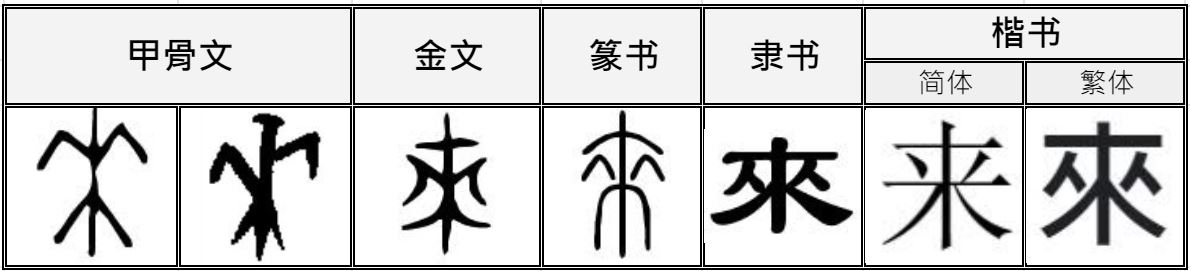
Looking at 来 and its traditional counterpart 來 itself, there is no much information provided. However recalling 木 we have learnt, 来 |  來 seems to be related to plants with roots drawn at the bottom. To confirm our guess, let us examine its ancient scripts:

evolution history of 来

Now when we look at the Oracle script of 来: or , it is quite clear that it is some kind of herb. But why not grass you might ask? It is because we have already known that grass is represented by character 草.

If you knew the meaning of the Traditional Chinese character 麥, you would have realized that 来 | 來 has some connection with 麥, which is shown below:
wheat

Does not  vividly outline the ripe wheat with its ears hanging down in above picture?  

Yes, 来 | 來 originally represents the meaning of 麦 | 麥, which is wheat.

As you can see that eventually evolved to Clerical script, which is almost the same as its Traditional character we used now: 來.

Wheat is an agriculture crop Chinese ancestors imported from foreign countries, and wheat is taken as a blessing gift from heaven which helped to feed Chinese people for centuries. 

来 | 來 was then borrowed to mean comes from or arrives from. For example 来访.

And 来 | 來 can also be used to represent the meaning of to come or to arrive. For example 未来.

As mentioned above, since 来 | 來 has been used to represent different meaning other than wheat, Chinese ancestors created a new character 麦 | 麥 for it.

That is pretty much all for 来 | 來, let us enjoy a Chinese calligraphy with 来 | 來 inside:
盛年不重来,一日难再晨;
及时当勉励,岁月不待人。


Saturday, 29 May 2021

 Today we move on our learning journey to 方. This is a very simple Chinese character that provides little clue of what it is. Let us examine its ancient scripts to get more clues:

evolution history of 方


From its Oracle script , we can tell that it can be divided into parts of and . It is believed that represents man, and represents an ancient Chinese shackles used to exile criminals, as shown below:


方 originally means exile criminals into desolated border of a country.

From its original meaning, 方 is extended with following meanings:
1. border or side: for example: 四方形
2. Chinese ancestors believes that Heaven is round, while earth is a square at its border, 方 thus contains meaning of square: for example: 方方正正
3. a place at border means it is far away from central of the country, 方 has the meaning of local, for example 方言
4. 方 thus also has the meaning of a place or a county, for example 地方
5. exile to borders means travel to that direction: for example 方向

That is pretty much all for 方, time to enjoy a Chinese calligraphy with 方 inside:

大风起兮云飞扬, 威加海内兮归故乡, 安得猛士兮守四方.


Saturday, 24 April 2021

远 | 遠

Today we move on to a simple add-on to our Chinese character family based on 元 and 袁 we just learnt - 远, whose Traditional Chinese character is 遠.

Looking at 远, it is composed of 元 and 辶, we already know that 元 can mean start, while 辶 is 辵 which means walk. So 远 means start to walk? This is a bit ambiguous for what it really represents.

Let us leave 远 aside for a while and look at its counterparty 遠. 遠 is composed of 袁 and 辶. 袁 we know that its original meaning is "to take a cloth". So 遠 means to take a cloth (with you) and walk, which in term means that you would travel far away from home.

That is it, 远 | 遠 means far away. for example 远方.

As usual, below is the evolution history of 远 | 遠:

evolution history of 远 | 遠

And enjoy a Chinese calligraphy with 远 | 遠 inside:

远- 非淡泊无以明志;非宁静无以致远。


Saturday, 27 March 2021

 Today we move on to a few Chinese character 袁, which is related to 衣 we just learnt. From the modern form 袁, we can tell that its bottom part  is part of the 衣. By looking at its ancient scripts, it is even more obvious:

evolution history of 袁


Oracle script is quite obvious to have a hand which holds a cloth . Another Oracle script added the round collar of the cloth. And Bronze script moved the hand to upper part of 袁. Following characters of 袁 followed the pattern of Bronze script till current Regular script 袁.

So 袁 contains the original meaning of "taking a cloth", usually it refers to taking spare clothes when you would like to travel far away from home. 

In ancient China, there is one officer whose duty is to prepare clothes for kings or governors. As part of the usual practice of Chinese ancestors, his descendants started to use 袁 as their family name. Now 袁 is used as family name only.

In order to represent the original meaning that 袁 represents - to prepare clothes for travelling away from home, Chinese ancestors added 辵, whose simplified version 辶 (details at https://xiongzou.blogspot.com/2015/11/learn-one-chinese-character-day_14.html) to 袁 to represent meaning of far away, which Chinese character we will study in our next post.

That is all for 袁, now it is time to enjoy a Chinese calligraphy with 袁 inside:

致远 - 袁江

Saturday, 30 January 2021

Before we move on to our character 远 or its Traditional counter party - 遠, we need to prepare ourselves with good understanding of 元 and 袁 first.

Today we will study 元. It is quite clear that, 元 is composed of 二 and 儿. Does it mean 2nd kids in the family? Sounds interesting. Let us see if we can confirm our guess with its ancient scripts.

evolution history of 元


Looking at Oracle script of however,  its upper part in Oracle Script is actually Chinese character 上 (details can be found at https://xiongzou.blogspot.com/2017/10/learn-one-chinese-character-day.html) instead of 二. Since refers to a person without doubt, the drawingthus should contain two potential meanings:

1. something above a person: sky or heaven.
2. upper part of a person: header.  

Actually both are the original meaning of 元. Just another Chinese character 天 was created to dedicate to mean sky or heaven.

for example in 元气, 元 means sky or heaven. and in 元首, 元 means head.

Same as English word head and heading, our Chinese character 元 contains the same context and is borrowed to represent meaning of first, beginning, origin, above or primary

Till now we full prepared ourselves to understand the first public holiday in China, which is 元旦. Translation of 元旦 literally is first sunrise, which means first day of a year!

Do not forget the meaning of sky and heaven that 元 represents as well! As great as the sky, 元 is also used to mean great.  for example: 元勋.

That is all, time to enjoy a Chinese calligraphy with 元 inside:

元德