Saturday, 2 July 2022

面 | 麺 | 麪

Our character today continues with 面, but it has a total different meaning than face. It is quite obvious with its Traditional Chinese Character counter-party: 麺.

麺 is consisted of 麦, which we know to mean wheat, and 面, which we just learnt to mean face. So what does it mean by face of a wheat?

Actually 麺 does not mean face of a wheat, it is a Phonogram character, 麦 is used to emphasize that 麺 related to wheat, while 面 is its pronunciation part. 麺 pronounces exactly the same as 面.

麺 means noodle. for example 麺条.

面条

面 is its simplified version with 麦 removed. So we can also say 面条.

There is another Traditional character of 麺, which is 麪. Right hand part of 麪 is 丏(whose pronunciations is also mian3).

That is all for 面 | 麺 | 麪, time to enjoy a Chinese calligraphy with 面 | 麺 | 麪 inside:

千人千面


Saturday, 11 June 2022

We have accumulated a lot of basic Chinese characters during our past learning journey that we can use to assemble more complex characters. While pick up low hanging fruits, we will continue to equip us with new basic characters like this one today: 面.

It is not that easy to guess the meaning of 面 by looking at its modern way of writing. As usual, 面's evolution history will help:

evolution history of 面

Inside the Oracle script , there is a drawing of , which we can recognize easily as drawing of an eye. is Chinese character 目. We can found its detailed explanation at  https://xiongzou.blogspot.com/2011/12/learn-one-chinese-character-day_18.html

Its another Oracle script  emphasizes its relationship with a human.

When it evolved to Seal script , it is much clear that refers to eye. However what does the surrounding referring to? Combined with meaning of 面 we know today, is the outline of a face.

Chinese ancestors noticed eyes as the most obvious and important part of our face and draw it together with the outline of a face to represent the meaning of face:   .

When time passes,  was simplified to our current way of writing: 面, which pretty much lost its original drawing.

So 面 means face as noun. for example 面部.

面 can also be used as verb to mean facing or face to face. for example 面壁,  面谈.

What we facing can refer to a direction or position. for example 前面, 后面.

Face is what we can see from a person, 面 is also used to represent meaning of surface: 表面.

That is all for 面 today, time to enjoy a Chinese calligraphy with 面 inside:

胜日寻芳泗水滨,无边光景一时新;
等闲识得东风面,万紫千红总是春。


During Chinese New Year holiday, you might have seen Chinese families put up couplets and 福 on their main doors to celebrate their most important holiday in a year.


Today we move on to explain what 福, which Chinese like the most, means and represents.

 As we learned with 祝 at https://xiongzou.blogspot.com/2020/05/blog-post_23.html , left hand part of 福: 礻is Chinese Radical form of 示, which is the altar for worshiping, with details at https://xiongzou.blogspot.com/2020/04/blog-post_26.html. So we know that 福 should be related to worshiping gods.

Then what does right hand part of 福: 畐 mean? 畐 seems to be composed of 一口田. Does 福 mean to pray to gods for having a piece of farm land? With such questions in mind, let us examine the evolution history of 福 to understand 福 better:

Evolution history of 福

Now we can see clearly from ancient scripts of 福 that its right hand side is the drawing of a wine vessel. It is particularly obvious with in and in . And during Bronze Script era, the vessel was simplified and transferred into , which was further simplified into 畐 in Seal Script. 

Below is a typical traditional wine vessel used in ancient China:

Examining carefully that we can see there is actually two hands offering onto altar. In 福's evolution process, the was simplified away.

福 is now obvious to have original meaning of offering wine to worship gods.

so 福 contains all the blessings, goodness and fortunes we pray to gods to grant us. To be more specific: Healthy, Wealthy, Safety and Peace. for example 福气.

And wine is brewed from rice. If an ancient Chinese family had extra rice to brew wine and not only that, they had wine reserved to offer to gods,  it was a clear sign of blessing that this family got a bumper harvest. for example 祝福.

That is all for 福, time to enjoy a Chinese art with 福 inside:


Friday, 6 May 2022

亏 | 虧

Today we move on to a character related to 乎 and 兮 which we have learnt before - 亏, whose Traditional Chinese character is a quite complicated: 虧.

We know that 乎 means shout out aloud, while 兮 is used to mean sigh softly. 亏 with a dash above is believed to mean no sound can be made.

Regarding its Traditional counterpart - 虧, it is believed that 虧 was created during era of Qin dynasty as there is no 虧 found in neither Oracle scripts nor Bronze scripts. 

We can see that 虧 is composed of two parts: 雐 and 亏, where 雐 is used to describe a bird exists only in ancient Chinese fairy-tells. Looking at 雐 carefully, with its upper part as 虍 and lower part as 隹, 雐 is a bird (隹) with a head as that of a tiger (虎). To me, 雐 should be originated from Owl whose Chinese name is 猫头鹰. 猫头鹰 is literally cat-head eagle. When Owl flies, there is too little sound to be heard by its prey. I believe Chinese ancestors noticed such characteristics of Owl and added 雐 to 亏 to emphasize the meaning of soundless.

Owl - 猫头鹰

So 亏 | 虧 contains the meaning of lost of sound, which was extended to mean lost / lose. for example 亏本.

It is fortunate for Owl to make no sound in catching its prey,  亏 | 虧 contains the meaning of lucky or fortunate. for example: 多亏你提醒.

As Owl is a symbol of ominous in Chinese culture, what is good for Owl is not good for us. 亏 | 虧 is thus also used as irony to mean reprimand or ridicule: 亏你做的出来.

That is all for 亏 | 虧, time to enjoy a Chinese calligraphy with 亏 | 虧 inside:

吃亏是福


Tuesday, 8 March 2022

Today we move on to another Pictogram character 雀. 

At the first glance, its top part is an obvious Chinese character 少, which we have learnt at https://xiongzou.blogspot.com/2016/01/learn-one-chinese-character-day_22.html . 少 means less or small.

Bottom part of 雀 is unknown to us. We will need the help of its ancient scripts:

雀evolution history

 
Now we can clearly see that bottom part of its Oracle Scripts and is drawing of a bird (details can be found at https://xiongzou.blogspot.com/2017/12/learn-one-chinese-character-day_18.html). so and is to mean small bird, like sparrow. 

Its Bronze Script and Seal Script and Clerical Script were slowly simplified to our current writing form: 雀.

雀 means small bird. for example: 麻雀.

Now it is time to enjoy a Chinese calligraphy with 雀 inside:

鸣蝉移树流余响,斗雀追风坠细翎。

Sunday, 6 March 2022

 Chinese New Year 2022 is year of tiger. Today we divert our path to learn tiger in Chinese: 虎.

Modern character of 虎 does not give us much hint why it means tiger. As usual its ancient scripts will help here:

evolution history of 虎

As we can see from above table how 虎 evolved from its vivid drawingwith the details of special characteristics of a tiger:
a. big mouth with sharp teeth;
b. stripes on its body;
c. powerful claws;
d. long tail;
to a more abstract  in Bronze script era, and further simplified in Seal script  and finally fixed in Clerical script: .


so 虎 means tiger. For example: 老虎.
With extended meanings, 虎 can be used to describe as dangerous as close to a tiger: 虎口.
And 虎 can also be used to describe a person as mighty and brave as a tiger. For example: 虎将. 

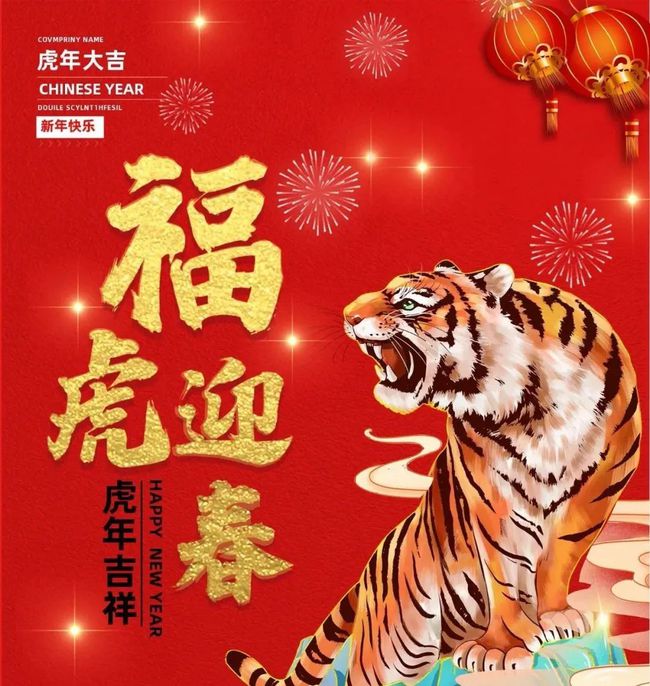
That is all for 虎. I wish everybody a Prosperous Chinese New Year of Tiger | 虎年大吉:
福虎迎春

Sunday, 13 February 2022

We have learnt 乎 before and now we are going to examine its close relatives: 兮. From their modern form, we probably would not be able to tell how close they are, but if we compare their Oracle scripts, it will become obvious.

Oracle script of 乎: . Detailed explanation of 乎 can be found at https://xiongzou.blogspot.com/2020/07/blog-post.html 

Oracle script of 兮: 


We know that of is to represent air flow that produces load sound. Now comparing  with , we can tell that should be drawn to represent a sound that is lower than .

Before we move on to conclusion, let us examine 兮's evolution history:

evolution history of 兮

兮 means to produce a lower sound than 乎, probably a sound at the level of a sigh. normally used as a modal particle per Chinese grammar, like 乎.

That is all for 兮, time to enjoy a Chinese calligraphy with it inside:

归去来辞:归去来兮,田园将芜胡不归,既自以。。。