Tuesday, 20 December 2016

Learn one Chinese Character a day - 门 | 門

We have learnt enough characters inited from 皿. Today we are moving forward to our new character - 门 | 門, which is another example why Traditional version is a better choice for mastering the meaning of a Chinese character.

Referring to its Traditional version - 門, its meaning would be very obvious after viewing its actual object below:
门 | 門
So yes, 门 | 門 is another Pictograph (象形)  character, which is a pictorial drawing of a double door. 

To have a even better understanding of 門, let us examine its evolution history (image taken from http://vividict.com)
Learn one Chinese Character a day - 门 | 門
Oracle Script of 门 -  is almost same as our modern Traditional character 門, with two panels -  and . Current Simplified version 门 comes from its Cursive Script  obviously.

As clear as it is drawn, 门 | 門 means double door and is eventually used to mean door, and all the extended meaning the English word door has as well. We need to go through door to enter or leave a house, 门 | 門 also means Gateway.

For door turns around its vertical supporting frame while it is opening or closing, 门 | 門 is extended to mean valve as well.

And 门 | 門 is the entrance to a house where a family lives, it became a symbolic of a family or a household. A big family grows to form their own group of people sharing same interests and separate themselves from other families, thus 门 | 門 is extended to mean faction while referring to people or category while referring to things. Extended further from here, while 门 | 門 is used as Chinese Radical, it can be used to quantify a group of people or a category of something, like 一门忠烈 or 一门学科.

That is all for 門, it is now time for us to enjoy a Chinese calligraphy with 门 | 門 inside:
九门

Sunday, 11 December 2016

Learn one Chinese Character a day - 盘 | 盤

Now we are fully prepared for reasoning the meaning of 盤 - a 皿 used to carry or move stuffs around. 

Its Simplified version 盘 uses 舟 instead of 般 comparing to its Traditional version 盤. Thus 盘 actually lost the correct context for its proper meaning. 

And it should be understandable that 盘 | 盤 is usually shallow and flat to make it easier to carry foods or other kitchenwares around. A typical 盘 is shown below:
盘 | 盤
And Some other 盘 | 盤 which is used to carry foods:
盘 | 盤
And we can confirm our observation from its evolution history: (image taken from http://vividict.com/)
Learn one Chinese Character a day - 盘 | 盤

Its Bronze Script   is exactly composed of (which is 般) and (which is 皿).

Based on its original meaning, Chinese ancestors started to extend it to include more meanings.

盘 | 盤 is extended to refer to anything shallow and flat which is used to hold something else, like chess board - 棋盘.

盘 | 盤 is then used as a Chinese Classifier (https://en.wikipedia.org/wiki/Chinese_classifier) to describe number of dishes: 一盘菜, or anything else on a 盘 | 盤, like 一盘棋.

盘 | 盤 naturally has the meaning of 般, so 盘 | 盤 contains meaning of move. And from the meaning of move, 盘 | 盤 is extended to contain the meaning of "Count or Verify in details (by moving items one by one)"

While a person sits like following picture by crossing his legs, it is kind of forming a 盘 | 盤 to hold himself. So 盘 | 盤 eventually contains the meaning of "to cross or to wind"
盘膝而坐
That is pretty much all for the character 盘 | 盤. It is now time for us to enjoy a Chinese calligraphy with 盘 | 盤 inside:
严寒(识)盘松

Monday, 5 December 2016

Learn one Chinese Character a day - 搬

Answer revealed, 搬 was created in place of 般 for its original meaning: "move / transport (people or goods) by boat", by adding another hand (手 transformed to 扌as Chinese Radical) to 般. So now you would not be surprised that 搬 pronounces exactly the same as 般.
搬
Evolution history of 搬 has been shown below: (image taken from http://chinese-linguipedia.org)

Learn one Chinese Character a day - 搬
Seal Script has the extra 手 added below 般, while its Clerical Script  has already changed to 扌which was put on the left side to 般.

So 搬 means to move (things around). And it is eventually extended to mean to move or stir up anything. For example: 搬弄是非 which means "stir up to sow discord among people".

That is it. Now time for us to enjoy its Chinese calligraphy:
运水搬柴皆是道,行住坐卧均为禅

Thursday, 1 December 2016

Learn one Chinese Character a day - 般

We have learnt 殳. For preparation of studying 盘 | 盤, today we continue our learning journey to 般.

Looking at 般 (pronounces bān), its left hand side is 舟,  which means small boat. And its right hand side is 殳 (pronounces shū), which we just learnt, means "holding a long rod". Now the meaning of 般 is clear: propel a boat by pushing a pole against the bottom of a river, canal, or lake, as shown below:
般

That is the original meaning of 般 - propel a boat by pushing a pole (carrying people or goods).

To double confirm our observation, let us examine its evolution history: (image taken from http://vividict.com/)
Learn one Chinese Character a day - 般
Oracle script of 般 - is now very clear that hold a pole () by hand () to propel the boat (). Current form 般 still has a very similar representation as its ancient scripts.

While we use small boat - 舟 to carry people or goods to cross rivers, each transportation was called 一般. As boat was normally dedicated to carry either people or goods, 般 was then eventually borrowed to be a Chinese classifier (https://en.wikipedia.org/wiki/Chinese_classifier) which means kind / sort / type. For example 一般 now means "one kind of".

For 般 has been borrowed to mean something else, as they always did, Chinese ancestors then created a new character to represent the original meaning of 般. If you followed our lessons closely and learnt how characters were created after the original one was borrowed to contain extended meanings, you might have known which the new character is?

Now it is time for us to enjoy a Chinese calligraphy with 般 inside:

般若

Monday, 28 November 2016

Learn one Chinese Character a day - 殳

To learn a new Chinese character 盘 | 盤, we need to prepare ourselves with some other Chinese characters, otherwise you might wonder how come a type of kitchenware can be related to a boat?

Today's character 殳 is one of that. What does 殳 mean then? We can only know that lower part of 殳, which is 又, refers to hand. What is its upper part here? You might have said that was 几, which means a small table. Let us check its evolution history to double check: (image taken from http://chinese-linguipedia.org/)
Learn one Chinese Character a day - 殳
Now we can tell clearly that 殳 is to mean holding a long rod with one big end.

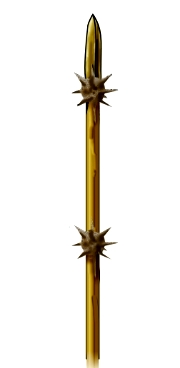
In ancient China, soldiers normally used a long rod with one end tied up with sharp stones or metals, as shown below. Thus 殳 is borrowed to mean such weapon.
殳
Its original meaning, however, is preserved while 殳 is used as a Radical. For example the Chinese character 般 we are going to learn next.

Before that let us enjoy a Chinese calligraphy with 殳 inside:
殳篆

Thursday, 24 November 2016

Learn one Chinese Character a day - 尽 | 盡

Our new character today has a very different Traditional version - 盡 than its Simplified version - 尽. This is another example why I like Traditional version more than the Simplified counterpart.

Though there are certain transfiguration comparing its Traditional version 盡 with its Oracle Script, 盡 is still quite clear of what it tells. Below is the evolution history of 盡 | 尽 (image taken from http://chinese-linguipedia.org/)
Learn one Chinese Character a day - 尽 | 盡
Looking at its Oracle Script it is a vivid view of "using a brush to wash a container by hand ", as shown in below picture:
盡
Its Seal Script presents a more vivid view of the same.

That is the original meaning of 盡. Now looking back at 盡 again, is not the current Traditional version 盡 preserves the same view still?

And we can also tell that the Simplified version 尽 is obviously inherited from its cursive script (草书, cǎoshū, literally "grass script") - 

While we start to clean a container, it means that everything in that container has been finished.
So 盡 | 尽 is used to mean finish as verb, or finish / end as noun.

related to 盡, there is another Chinese character 儘 (adding a 人 to 盡) or its Simplified version 侭 (adding a 人 to 尽), which means that a 人 has tried all his best or used up all his resources. Chinese ancestors eventually merged back 儘 to 盡 or 侭 into 尽.

Thus 盡 | 尽 now has the meaning of 儘 | 侭 that: (a 人) tried all his best or used up all his resources. And it is later extended to mean all. 

Before ending our lesson today, let us enjoy a Chinese calligraphy with 尽 |  盡 inside:
白日依山尽,黄河入海流;
欲穷千里目,更上一层楼。

Friday, 18 November 2016

Learn one Chinese Character a day - 盅

Today we continue to examine another Chinese character related to 皿 - 盅. It is composed of 中 and 皿. Both of them have been learnt. 盅 is then obviously some kind of 皿 (container). What's the meaning of 中 here then? Quite clueless. Let us see whether ts ancient scripts can provide us more ideas if any. (Image taken from http://vividict.com)
Learn one Chinese Character a day - 盅
Its Bronze Script (with  and  ) represents exactly the same concept as its current form 盅. It is then still impossible for us to reason its meaning properly. However if you have any good interpretation, please do share your thoughts.

So today we do the opposite way to see whether we can appreciate how 盅 was created with knowing its meaning: 

盅 means handleless cups (normally small in size and are used for serving Chinese tea or Chinese spirit), as shown below the small cup receiving tea:
盅 for tea
And 盅 in big size is usually used as slow cooker for soups, like:

盅 for soup
From the drawing of , it actually has handles. 中 which has meaning of middle, is believed to emphasise that 盅 refers to the middle part of  without handles. And 中 also works as the phonetic indicator that 盅 pronounces same as 中.

Now we have learnt the meaning of 盅, it is time to enjoy a Chinese calligraphy with 盅 inside:
蹈盅

Saturday, 12 November 2016

Learn one Chinese Character a day - 溢

Answer revealed, 溢 is the character we mentioned in our last lesson that Chinese ancestors created in place of 益. Following the same way how 沙 was created, water was added to 益 to create 溢 to present the original meaning of 益 - water overflows.

And that is consistent with our observation that: when water is used as Radical to form other Chinese characters, it is normally simplified as .

We then would also not be surprised that 溢 pronounces exactly the same as 益.

And eventually 溢 is extended to mean overflow of anything. For example overflow of buffers in C programming language.

To confirm our understanding, let me go through the evolution history of 溢: ( image taken from  http://vividict.com)
Learn one Chinese Character a day - 溢
As we can see that Oracle Script of 溢 is same as that of 益 - 
Now it is time to enjoy a Chinese calligraphy with 溢 inside:
福杯满溢